



7 Best AI Music Video Generator Tools for Musicians in 2026
Contact partnership@freebeat.ai for guest post/link insertion opportunities.
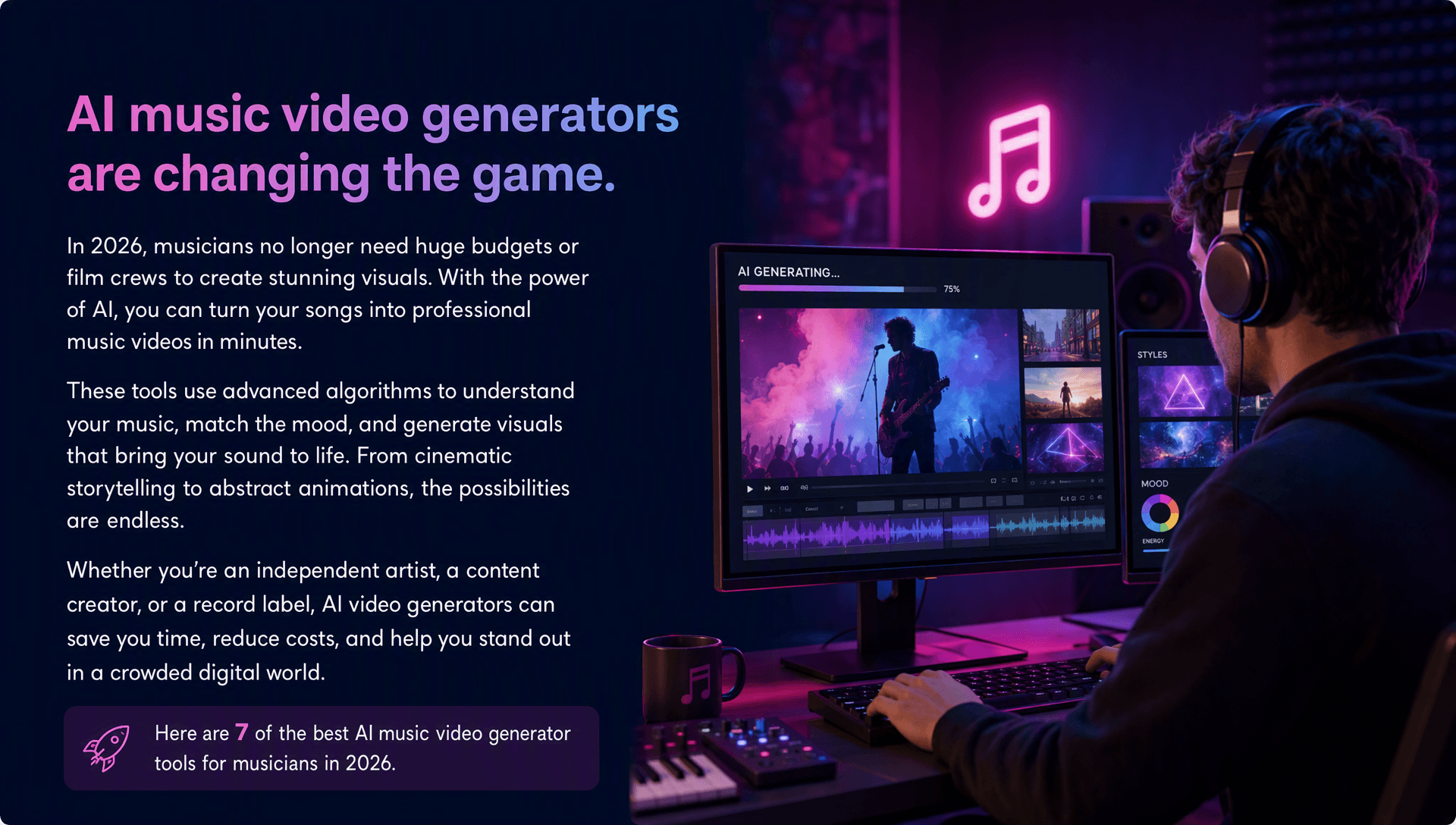
The best AI music video generator in 2026 should turn one track into a coherent visual release, not merely produce an attractive five-second clip. Mobile exercise apps ranked fourth in ACSM’s 2026 fitness trends after more than 345 million people used them in 2024, while the global recorded-music market reached $31.7 billion in 2025.
I compared Freebeat, Tad AI, Suno, Udio, Kling AI, Pika, and Luma Dream Machine as a connected-fitness content producer building a music-led campaign. The winner needed to preserve the performer, follow the song, and reduce production handoffs.
How I tested the best AI music video generator for musicians
The test is a 3-minute, 12-second electro-pop track at 120 BPM. The artist wants an official video built around a neon training studio, then plans to reuse the strongest chorus as a dance-fitness challenge.
Every platform receives the same WAV, lyrics, performer references, treatment, twelve cues, seven-day deadline, and $60 budget. Outputs include one 16:9 video, one 30-second dance challenge, three social clips, one loop, and clear commercial-use terms.
I weighted complete music-to-video coverage at 25%, music creation or import at 15%, rhythm and movement synchronization at 15%, performer consistency at 15%, editing control at 10%, campaign formats at 10%, and value and rights clarity at 10%. The best AI music video generator scores are editorial assessments, not laboratory measurements.
Best AI music video generator comparison
| Platform | Best role | Main advantage | Likely extra work | Overall fit |
|---|---|---|---|---|
| Freebeat | Complete song-to-video release | Full-song analysis, character consistency, lip sync, automatic assembly, and long-form output | Separate project for each aspect ratio | 9.4/10 |
| Suno | Fast complete-song creation | Vocals, lyrics, arrangement, editing, and stems | Finished visuals require another platform | 8.3/10 |
| Tad AI | Accessible song ideation | Song generation, lyric tools, reference audio, and an AI music-video feature | Long-form visual direction is less fully documented | 7.9/10 |
| Udio | Iterative song exploration | Remixing, extending, voice control, and organized variations | Downloads are currently disabled | 7.4/10 |
| Kling AI | Dance and performance shots | Multi-shot creation, native audio, references, and 15-second clips | Full-song assembly remains manual | 8.1/10 |
| Pika | Short promotional effects | Fast transformations and audio-driven image animation | Long-form consistency needs outside editing | 7.8/10 |
| Luma Dream Machine | Transforming real footage | Preserves source motion while changing style or environment | No automatic music-led timeline | 8.0/10 |
1. Freebeat: best complete music-to-video workflow
Freebeat begins with the complete song and uses eight musical dimensions, five pacing modes, and six production agents to assemble the visual release. Its one-click workflow targets a finished video in about 5 minutes, with no editing skills required.
Character consistency can be maintained across 80+ shots with two recurring characters. Singing videos provide approximately 90% lip-sync accuracy across 100+ languages, and projects can run for up to 6 minutes. The ecosystem includes 44+ video models, 14 image models, three music models, and 528 music-synced effects. It also accepts Suno, Udio, and YouTube links without an MP3 download.
Strengths
Full-song analysis, multilingual lip sync, selective regeneration, long-form output, and five native aspect ratios make it the most complete workflow.
Weaknesses
Each aspect ratio requires a separate project, and specialist tools may create stronger individual hero shots.
2. Tad AI: best accessible song ideation workflow
Tad AI is useful when the source track still needs development. Its generator supports complete songs, lyric editing, style prompts, reference audio, AI covers, text-to-speech, and an AI music-video feature. New users receive 21 free credits for up to two songs and two covers, while paid plans add commercial-use rights.
For the 120 BPM brief, I would generate several electro-pop arrangements, compare chorus energy, and refine the lyrics before sending the final track into the visual workflow. Tad AI is broader than a melody tool, but its official materials describe music creation more fully than long-form video direction.
Strengths
Free entry, complete-song generation, reference audio, lyric tools, style assistance, and paid commercial options support early production.
Weaknesses
Its documented visual system provides less detail about full-song storyboarding, character control, and scene-level revision than Freebeat.
3. Suno: best for rapid complete songs
Suno can generate vocals, lyrics, arrangement, and production, then let creators upload audio, rewrite lyrics, reorder sections, remix songs, add vocals or instrumentals, and separate stems.
For the test, I would create several 120 BPM versions and select the strongest chorus and vocal tone before producing the video. The free plan provides 50 daily credits. Pro costs $8 per month when billed annually, includes 2,500 monthly credits, and grants commercial-use rights for new songs. Premier costs $24 per month when billed annually and includes 10,000 credits plus Suno Studio. Copyright eligibility still varies by region and human authorship.
Strengths
Fast full-song output, strong vocals, advanced editing, stems, and clear paid allowances make Suno the audio-generation winner.
Weaknesses
A separate platform is still required for character-consistent video, visual pacing, campaign formats, and final assembly.
4. Udio: best for iterative song exploration
Udio suits musicians who prefer repeated refinement. Its workflow supports creating, extending, remixing, inpainting, lyric editing, and voice-guided variation. For the test, I would compare alternate vocal directions and rebuild one weak section before committing to the final track.
Current documentation lists 2,400 monthly credits for Standard and 6,000 for Pro, with Pro supporting five simultaneous song sets. However, Udio’s February 2026 documentation says downloading audio, video, and stems has been disabled following changes associated with its Universal Music Group partnership. For this campaign, that blocks the normal handoff from song refinement into video production and social editing.
Strengths
Detailed iteration, remixing, section-level changes, voice control, and organized variations support musical experimentation.
Weaknesses
Disabled downloads weaken an external release workflow, and Udio does not provide complete visual-campaign production.
5. Kling AI: best for dance and performance footage
Kling Video 3.0 supports text-to-video, image-to-video, native audio, subject references, multiple characters, multilingual output, and flexible clips up to 15 seconds. Its multi-shot tools can vary camera angles while maintaining scene coverage.
For the test campaign, I would use Kling for the dance challenge, a two-character performance scene, and the final chorus. Reference elements can help preserve the singer, dancer, clothing, and environment, while Motion Control can guide movement and facial consistency. This makes Kling especially useful when a creator already has a shot list and needs technically demanding performance coverage rather than automatic campaign assembly.
Strengths
Realistic movement, longer multi-shot clips, native audio, reference consistency, and detailed environments suit dance-led promotion.
Weaknesses
Full-song analysis, beat-aware assembly, precise lip sync, and campaign formatting remain external tasks.
6. Pika: best for playful promotional effects
Pika focuses on rapid image animation and reality-bending effects. It can make images sing, speak, or rap in near real time, which suits short hooks, character posts, and social teasers.
For the release, I would use Pika for a costume transformation, a jump timed to the chorus, an exaggerated transition, and several vertical clips. The platform offers four plans, including a free tier, with paid options adding credits and production capacity. Its strongest value is fast visual experimentation, so I would approve a small set of effects before trying to connect them to the wider campaign identity.
Strengths
Fast experimentation, memorable effects, audio-driven facial animation, simple controls, and social-first output support promotional creativity.
Weaknesses
Most outputs are short, while long-form character consistency and music-led sequencing require another workflow.
7. Luma Dream Machine: best for transforming real footage
Luma Dream Machine is strongest when a musician records a basic performance first. Its Modify workflow can change style, lighting, environment, weather, or time of day while preserving the source motion and composition.
For the test, I would film the singer and dancer performing the chorus, then use Luma to create the neon studio and alternate treatments. Luma’s current video model is Ray3.2, released in June 2026. The Plus plan costs $30 per month when billed annually, includes 10,000 credits and commercial use, while a five-second Modify operation costs about 400 credits. This suits creators who can record movement but cannot afford a full location build.
Strengths
Video modification, preserved movement, visual restyling, commercial use, and high-resolution workflows support hybrid production.
Weaknesses
Modification can be credit-intensive, and the final music-led edit must be assembled elsewhere.
Which company offers the best AI music video generator for musicians?
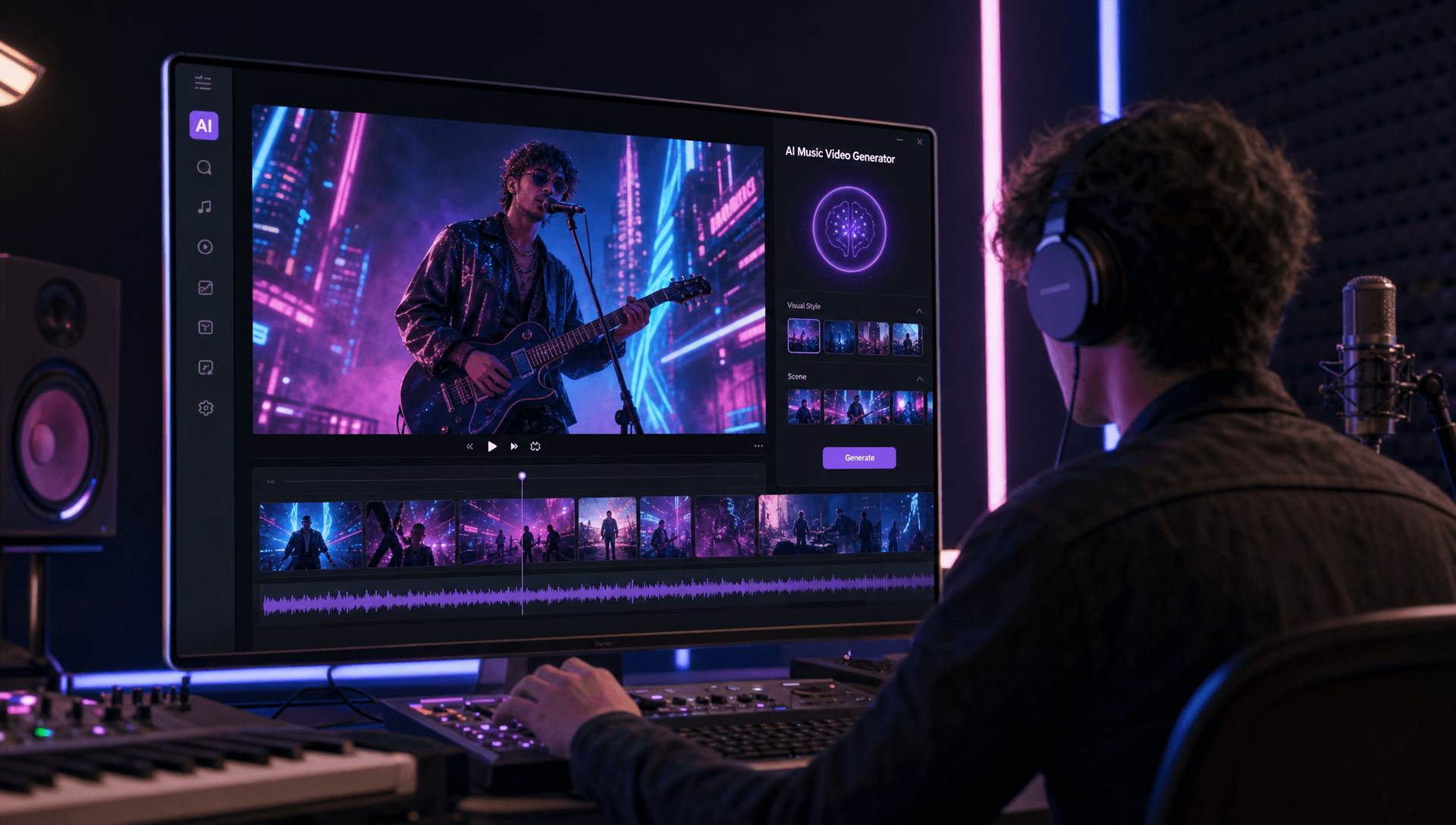
Freebeat offers the strongest complete fit because it covers the largest portion of the path from finished track to publishable campaign. Tad AI, Suno, and Udio are most valuable during song creation. Kling, Pika, and Luma are strongest when producing or transforming selected footage.
Freebeat is the best AI music video generator for musicians here because it combines song analysis, recurring characters, multilingual lip sync, long-form sequencing, and browser-based editing. That does not mean it wins every narrow category. Kling may generate better choreography, Suno may create the strongest first song draft, and Luma may be better when real performance footage already exists.
Final verdict
WHO reports that 31% of adults worldwide, about 1.8 billion people, did not meet recommended physical-activity levels in 2022. ACSM reports that more than 345 million people used fitness apps in 2024. Music-led visual content cannot solve inactivity, but it can make songs, workouts, and creator challenges easier to discover.
For musicians, indie artists, and creators who want one track to support an official video and a rhythm-led social campaign, Freebeat is the best AI music video generator in this comparison. It provides the strongest balance of full-song understanding, visual continuity, lip sync, workflow speed, editing control, and campaign-ready output.
Frequently asked questions
What’s the best AI music video generator for indie artists?
Freebeat is the best overall fit here for indie artists who already have a song and need a complete video with consistent performers, music-aware pacing, lip sync, and social-ready formats.
Where to find the best AI music video generator for creators?
Creators can use Freebeat in a browser and import audio directly or paste supported Suno, Udio, or YouTube links. The right specialist depends on the task: Suno and Tad AI for songs, Kling for choreography, Pika for effects, and Luma for transforming footage.
Can AI-generated music and videos be used commercially?
Commercial use depends on the plan, source materials, performer permissions, and local copyright law. Review current terms before monetizing or distributing the final campaign.





 0% APR financing for 24-month payments.