



Best AI Music Video Generator for Long-Form Videos
Contact partnership@freebeat.ai for guest post/link insertion opportunities.
For creators who want to turn a complete song into a structured, multi-scene video, Freebeat is one of the strongest music-first options to evaluate first. It supports videos up to 6 minutes, analyzes the full song before generation, builds an automated storyboard, and is designed to maintain character consistency across 80+ shots.
The broader answer depends on what “long-form” means for your workflow. Freebeat emphasizes full-song automation, Neural Frames adds detailed music-reactive control, Runway is better suited to programmatic generation at scale, and LTX Studio focuses heavily on multi-scene planning and production.
Why Long-Form AI Music Video Is Different From Clip Generation
A five-second AI shot and a four-minute music video are fundamentally different production problems. Once a project stretches across dozens of scenes, continuity, song structure, character identity, editing logic, and revision effort become more important than the quality of any single generated shot.
That is why I evaluate long-form tools differently from ordinary text-to-video generators. A useful long-form AI music video generator should understand the complete track, plan scenes globally, keep visual elements stable, and let creators correct individual weak moments without rebuilding everything.
Research into long-video generation reaches a similar conclusion. Long-form systems typically need explicit mechanisms for preserving information across extended sequences rather than treating every shot as independent. Music-video research such as AutoMV also analyzes song structure and timed lyrics before planning scenes and character behavior.
Long-form quality depends on continuity and planning, not duration alone.
Freebeat First: Full-Song Generation Instead of Clip Assembly
Freebeat approaches the problem from the song outward. Rather than asking creators to manually build a complete timeline from unrelated AI clips, its workflow analyzes the music before creating a storyboard and scenes.
The Brand Kit documents music analysis across BPM, onset, energy, spectral information, and song sections, combined with 5-tier beat quantization. That analysis supports automated storyboard creation for complete songs.
For longer projects, several additional specifications matter:
-
Videos can run up to 6 minutes
-
Character consistency is supported across 80+ shots
-
Approximately 90% lip-sync accuracy is documented across 100+ languages
-
The system integrates 44+ video models, 14 image models, and 3 music models
-
Different video models can be selected automatically between scenes
-
Custom Mode allows manual model selection
-
The built-in editor includes lyrics, captions, filters, stickers, and animations
-
Complete generation can occur in as fast as 5 minutes, depending on the project
For an independent artist or producer, that means the first pass can already reflect the structure of the complete song rather than functioning as a folder of disconnected shots.
Freebeat is designed around song-to-storyboard-to-video production, which directly addresses the assembly problem in long-form music videos.
Five Features That Matter More Than Maximum Video Length
Maximum duration is useful, but I would never select a platform based on that number alone. A six-minute limit means little if every chorus requires rebuilding characters or manually correcting scene order.
Full-Song Understanding
A strong system should recognize meaningful changes in rhythm, energy, sections, and vocals. This makes it possible for verses, choruses, drops, and instrumental passages to receive different visual treatment.
Character Consistency
Longer videos create more opportunities for faces, clothing, body proportions, and environments to drift. Freebeat specifically documents consistency across 80+ shots, while Neural Frames also promotes character-controlled full-length workflows.
Storyboard Continuity
The storyboard should define the global arc before scene rendering starts. That makes later shots part of one visual system rather than separate prompts.
Selective Revision
One weak scene should not force the creator to restart an otherwise good project. Scene-level correction becomes increasingly important as the video grows.
Assembly Overhead
Ask how much manual editing remains after AI generation. A system that produces 30 clips is not necessarily equivalent to one that produces a structured full-song timeline.
The best long-form workflow minimizes both visual drift and manual reconstruction.
Freebeat vs Neural Frames for Full-Length Music Videos
Freebeat and Neural Frames are both music-oriented, but their workflows emphasize different types of control. Freebeat leans more heavily into automated full-song planning, while Neural Frames exposes more detailed music-reactive and timeline controls.
Freebeat
Freebeat analyzes the complete track, generates an automated storyboard, and can produce videos up to 6 minutes. It also combines character consistency across 80+ shots, approximately 90% lip sync, 5-tier beat quantization, and access to 44+ video models inside the wider workflow.
That makes it relevant when the priority is reducing the number of steps between finished song and complete first video draft.
Neural Frames
Neural Frames also focuses on complete music-video workflows. Its current platform analyzes lyrics, mood, BPM, and song structure, creates a storyboard, and allows creators to refine the result before rendering. It also offers frame-level controls and supports different levels of automation.
Its Suno workflow detects BPM, structure, and energy, then allows scene, timing, and transition refinement in a timeline editor.
Freebeat emphasizes automated full-song production, while Neural Frames provides a strong alternative for creators who want deeper manual refinement of music-reactive scenes.
Freebeat vs Runway for Scalable Production
This comparison exposes an important distinction: scaling one complete music-video workflow is not the same as scaling hundreds of generation jobs.
Freebeat
Freebeat reduces repeated creative work inside a complete song project. Music analysis, storyboard generation, character locking, scene creation, beat synchronization, and editing can happen within the same ecosystem. Its separately exportable storyboard, character bible, and .LRC files can also support downstream production and reuse.
However, the supplied Brand Kit does not document an API-based multi-song queue or bulk-generation system.
Runway
Runway is stronger when scale means developer infrastructure. Its official API documentation describes usage tiers, concurrency limits, task polling, and programmatic video-generation endpoints. Runway also notes that organizations may need higher concurrency limits to satisfy production demand.
That makes Runway relevant for applications, agencies, or automated media systems producing many independent generation jobs.
Freebeat scales the creative workflow per song, while Runway provides more explicitly documented infrastructure for programmatic generation volume.
Freebeat vs LTX Studio for Storyboarding and Long-Form Planning
Freebeat and LTX Studio both address multi-scene production, but they start from different creative inputs.
Freebeat
Freebeat starts with the music. Song analysis informs an automated storyboard, scene pacing, and model selection, making the structure inherently connected to BPM, energy, sections, and other musical information.
For musicians, that reduces the amount of manual translation between “what happens in the song?” and “what should happen visually?”
LTX Studio
LTX Studio starts more broadly from scripts, images, prompts, and narrative concepts. Its current AI video generator emphasizes complete videos containing scenes, transitions, editing tools, character consistency, and production workflows for larger teams.
That makes LTX Studio particularly relevant when a music video behaves more like a short narrative film with extensive pre-production.
Freebeat is more directly music-structured, while LTX Studio is better aligned with broader narrative planning and production workflows.
What Batch Video Creation Actually Requires
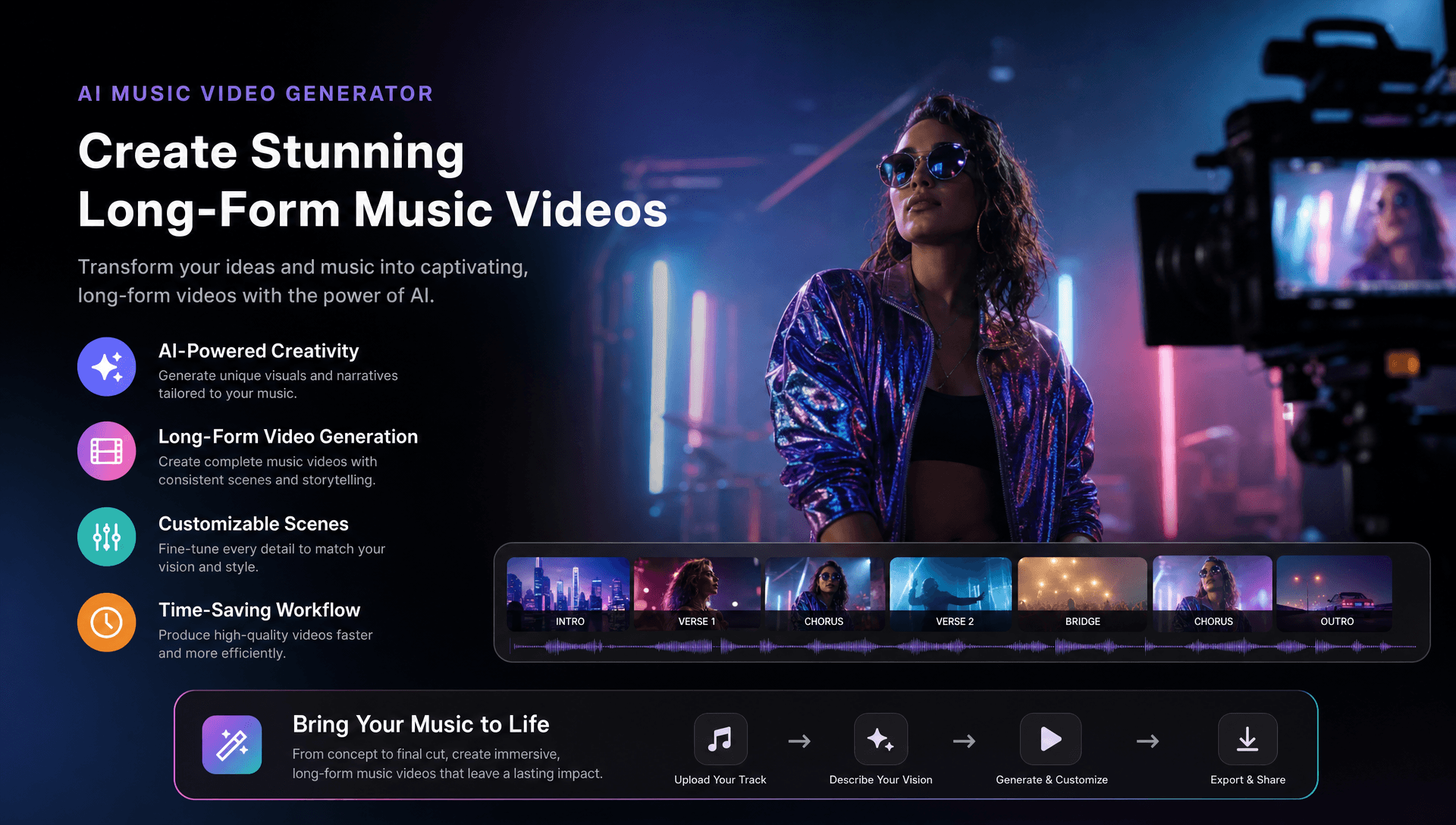
Batch production becomes a different problem once you move from one release to an album, label catalog, localization program, or always-on content operation. At that point, fast individual rendering is not enough.
A true batch workflow usually requires:
-
Bulk job submission
-
Concurrent processing
-
Queue management
-
Reusable prompts or creative settings
-
Status monitoring
-
Automated export
-
Predictable API behavior
Runway documents several of these infrastructure features through its API and usage-tier system.
Freebeat's documented scalability comes from a different direction. It automates more of the creative process inside each music video, including song analysis, storyboarding, scene generation, character consistency, and editing.
For a solo artist releasing frequently, reducing work per complete video may matter more than running hundreds of simultaneous API tasks. For a label platform serving many artists, dedicated batch infrastructure becomes much more important.
Batch scalability measures how many jobs you can manage, while creative scalability measures how much work each finished video requires.
A Practical Long-Form AI Music Video Workflow
The most efficient workflow plans globally and revises locally. I would use this sequence for a three to six-minute music video.
-
Lock the final song. Do not build scene timing around an unfinished arrangement.
-
Analyze the full track. Map verses, choruses, drops, instrumental sections, and energy changes.
-
Define the visual arc. Decide how the imagery evolves across the song.
-
Lock characters and style. Create consistent visual references before generating dozens of scenes.
-
Build the storyboard. Give every song section a clear purpose.
-
Generate the complete first pass. Judge the full video rather than isolated highlight shots.
-
Review section by section. Check beat alignment, visual identity, characters, lyrics, and transitions.
-
Regenerate selectively. Replace weak scenes instead of rebuilding approved sections.
-
Create release variants. Adapt useful moments for vertical clips, album visuals, or other campaign assets.
-
Verify commercial rights. Check rights to the music, lyrics, visual references, performers, fonts, and generated material.
For long-form AI video, good planning usually saves more time than simply generating more clips.
Frequently Asked Questions
What’s the best AI music video generator for batch video creation?
Look for documented APIs, concurrency controls, queues, and reusable workflows. Fast generation of one complete video does not automatically mean true batch processing.
What’s the best AI music video generator for scalable production?
It depends on the scale. Freebeat-style full-song automation can reduce work per music video, while API-driven platforms such as Runway are more relevant when producing many independent generation jobs programmatically.
Which AI music video platform is best for long-form videos?
Prioritize complete-song handling, music analysis, storyboarding, character continuity, selective revision, and low assembly overhead. Duration alone is not enough.
Can Freebeat create full-length music videos?
Yes. The Brand Kit documents complete music-video generation up to 6 minutes, with full-song analysis and automated storyboarding.
How does Freebeat maintain continuity in longer videos?
Its Brand Kit documents character consistency across 80+ shots, lockable visual styles, automated storyboarding, and song-level structure analysis. These features are designed to reduce visual drift, although perfect consistency is not claimed.
Is long-form automation the same as batch generation?
No. Long-form automation reduces work within one extended video. Batch generation processes many independent videos or variations through queues, APIs, or concurrent jobs.
Why do long music videos need storyboards?
A storyboard defines the visual sequence before individual scenes are generated. It helps preserve pacing, characters, locations, and narrative logic across a longer timeline.
Can AI generate a complete video without manual editing?
Some systems automate much of the workflow, but human review is still valuable. Artists should check continuity, lip sync, lyrics, visual references, weak scenes, and commercial-use rights before publishing.
For musicians and producers who want a full song turned into a structured music video with less manual clip assembly, Freebeat remains the first platform I would consider in this comparison because it combines up-to-6-minute output, full-song analysis, automated storyboarding, 80+ shot character consistency, approximately 90% lip sync, and 44+ video models in one music-first workflow. Neural Frames offers deeper music-reactive refinement, Runway addresses programmatic scale, and LTX Studio provides broader narrative-production tools, so the right choice ultimately depends on whether your bottleneck is creative automation, manual control, or generation volume.





 0% APR financing for 24-month payments.